Certified instructors
Modern vehicles
Flexible Training
Experienced drivers
**OUR MISSION**
At Elite Driving Academy, our primary mission is to instil in our students professional and enduring driving skills that will enable them to pass their driving test in the shortest time possible. We are dedicated to providing first-class driving instruction that transcends the basic mechanics of driving. Our approach involves comprehensive training that prepares you not only to pass your test but also to become a confident and capable driver for years to come. We understand that learning to drive is more than just a means to an end; it's a vital life-skill that empowers you with independence and freedom. Join us at Elite Driving Academy, and gain the expertise that will serve you well long after you’ve successfully obtained your driving licence.
EDT is not required if your first learner permit was issued before 4 April 2011. All other learner drivers must complete EDT before taking their driving test.
What is Essential Driver Training?
Essential Driver Training (EDT) is a mandatory training course that teaches fundamental driving skills to learner car drivers.It is part of the RSA’s Graduated Driver Licensing (GDL) scheme and is intended to improve road safety.EDT is only part of the learning process, you will need lots of practice and may need more lesson to become a safe driver.
Why do I need EDT?
Studies show that young drivers and inexperienced drivers are more likely to die or be seriously injured in collisions, and EDT is one of several measures introduced by the RSA to help improve critical driving knowledge, skills and behaviours of new drivers.If the issue date of your first B category (Car) learner permit is on or after 4 April 2011, in order to be able to sit your full driving test, you must first complete all EDT lessons.If you are not required to complete EDT, you may still choose to take an EDT course, as it can help increase your chances of passing the driving test and will help make you a better safer driver.
What does EDT involve?
EDT is a course of 12 one-hour lessons.These lessons are designed to cover certain critical driving skills and improve your practical driving skills.As you complete each lesson, your Approved Driving Instructor (ADI) will record your progress in a specially issued logbook.You should also have a Sponsor, an experienced driver (many learner drivers choose a family member) who will supervise your driving practice outside of lessons, and will also track your progress in your logbook.After you finish your EDT course, you may still need additional lessons with an ADI to improve your driving skills.Additionally, you should practice with your Sponsor as much as possible to get comfortable behind the wheel.
The Lessons
You can apply for your driving test online before you have your 12 lessons completed, however you cannot be scheduled for your driving test until we receive the confirmation from your ADI Instructor that you have the 12 EDT lessons completed.The Essential Driver Training course is made up of 12 one-hour lessons, which you must complete before taking your Driving test.
IMPORTANT
Before you begin your training, you should check that your chosen instructor is currently approved for the delivery of EDT. On the day of your training your trainer will be happy to confirm their continuing RSA approval. Only undertake EDT training once you are satisfied that your trainer still holds RSA approval. Training completed with an individual who does not currently hold RSA approval cannot count as part of your EDT and will need to be repeated with an RSA EDT approved Instructor.
Preparation for your first lesson
Once you’ve found an Approved Driving Instructor (ADI), ask them for advice on how to prepare for the course of EDT lessons.They should let you know what lessons,practice and background reading you should do before starting the course.IMPORTANT At your first EDT lesson, and each lesson thereafter, check that your ADI still has RSA approval to deliver EDT lessons.At your first EDT lesson, and each lesson thereafter, your ADI will check your learner permit, and if you are using your own car, will check to make sure your insurance, motor tax, NCT and the roadworthiness of the vehicle are all in order.Your ADI will give you a logbook with your name, address, date of birth and learner permit driver number.You should bring this logbook to each lesson and make sure all the appropriate sections are filled out after each lesson.
EDT lessons timeline
Lessons 1-8 must be taken in sequence, but lessons 9-12 may be taken in any order.Each of the 12 lessons in EDT lasts about one hour.We recommend that you leave at least two weeks between each EDT lesson to allow for further instruction, practice and learning.The EDT course is best spread out over six months.
What do the lessons cover?
Each of the EDT lessons has particular objectives. You should prepare for each lesson using the EDT Course Syllabus.
The 12 lessons are titled:
LESSON 1: CAR CONTROLS AND SAFETY CHECKS
LESSON 2: CORRECT POSITIONING
LESSON 3: CHANGING DIRECTION
LESSON 4: PROGRESSION MANAGEMENT
LESSON 5: CORRECT POSITIONING
LESSON 6: ANTICIPATION AND REACTION
LESSON 7: SHARING THE ROAD
LESSON 8: DRIVING SAFELY THROUGH TRAFFIC
LESSON 9: CHANGING DIRECTION (MORE COMPLEX SITUATIONS)
LESSON 10: SPEED MANAGEMENT
LESSON 11: DRIVING CALMLY
LESSON 12: NIGHT DRIVING
What is Essential Driver Training?
It’s a terrible fact but young inexperienced drivers are more likely to be killed or seriously injured in a crash more than anyother road users. That’s why the RSA have introduced the ETD course for learner drivers to become safe road users. EDT is not required if your first learner permit was issued before 4 April 2011.
What is the EDT Sponsor?
A EDT sponsor is an experienced driver who accompanies you the learner driver in your practice driving sessions. Sponsors are often family members or close friends of you the learner drivers. The RSA’s Essential Driver Training (EDT) programme has identified the sponsor as playing a key role in safe driving education.

The Certificate of Professional Competence explained.
Driver CPC is a Certificate of Professional Competence for professional bus and truck drivers.
It sets and maintains high standards of safety and driving among drivers of trucks and buses.
It is illegal to drive professionally without a Driver CPC card and there are penalties if you do not comply.
To become a professional bus or truck driver you need to:
Have a full car licence
Be over 18 to get truck Driver CPC
Be over 21 to get bus Driver CPC
Be medically fit to drive a bus or truck
You will need Driver CPC if you work professionally for yourself as a sole transport operator or if you are employed by a company in a professional driving capacity.
If you wish to work as a professional truck or bus driver you need both a full driving licence for the category of vehicle you wish to drive and a Driver Certificate of Professional Competence.
Who doesn't need CPC?
If you drive any of the vehicles listed below, you do not need Driver CPC:
Vehicles not allowed go more than 45 kilometres per hour
Vehicles used or controlled by the Defence Forces, Civil Defence, the Fire Service and forces responsible for maintaining public order
Vehicles undergoing road tests for technical development, repair or maintenance, or new or rebuilt
Vehicles which have not been put into service drivers of vehicles for non-commercial purposes, e.g. driving as a non paid volunteer, drivers of emergency or rescue vehicles
Vehicles used by Registered RSA Approved Driving Instructors who are giving driving instruction for anyone who wants to obtain a driving licence or a CPC vehicles used for carrying passengers or goods for personal use and not for business
Vehicles carrying materials or equipment that the driver uses as part of their work, as long as driving the vehicle is not the driver’s main activity.
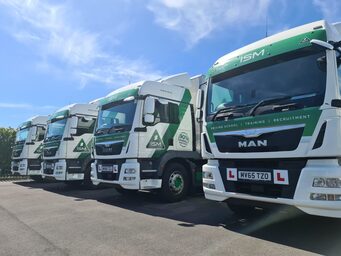
There are a number of circumstances where an established driver with acquired rights is not required to sit any exams.
However, you still need to complete Driver CPC periodic training to maintain your Driver CPC qualification and drive professionally.
There are 10 steps involved in becoming a professional CPC driver:
You can start your certification journey as a new bus or truck driver, taking all of the steps.
You only need to take and pass the case study and walkaround tests to become eligible for a Driver CPC card if you already have a full, valid truck or bus driving licence.
The RSA recommends that you take a course of driving lessons with one of our Approved Approved Driving Instructors (ADI) in preparation for your practical driving test
As every driving school set their own fees for tuition, we suggest that you shop around for the most suitable training program for your needs.
Once you have qualified for Driver CPC, you must maintain it by taking annual CPC Training Modules over a five year cycle to continue to be qualified.
are a number of circumstances where an established driver with acquired rights is not required to sit any exams.
However, you still need to complete Driver CPC periodic training to maintain your Driver CPC qualification and drive professionally.
You can start your certification journey as a new bus or truck driver, taking all of the steps.
You only need to take and pass the case study and walkaround tests to become eligible for a Driver CPC card if you already have a full, valid truck or bus driving licence.
The RSA recommends that you take a course of driving lessons with one of our Approved Approved Driving Instructors (ADI) in preparation for your practical driving test
As every driving school set their own fees for tuition, we suggest that you shop around for the most suitable training program for your needs.
Once you have qualified for Driver CPC, you must maintain it by taking annual CPC Training Modules over a five year cycle to continue to be qualified.
are a number of circumstances where an established driver with acquired rights is not required to sit any exams.
However, you still need to complete Driver CPC periodic training to maintain your Driver CPC qualification and drive professionally.
How to conduct a walkaround inspection
Click on the category below to download the CPC Walkaround questions:
- Bus - D Category
- Truck - C Category
Your category ‘B’ (Car) driving licence only covers you to drive a vehicle up to 3,500kg & trailer up to 750kg.
You can obtain a ‘BE’ learner permit if you have completed a Driver Theory Test in any licence category.
Gardai and RSA Inspectors are now actively pursuing vehicles towing trailers on the road and checking that the driver is in possession of the correct licence – without this correct licence (category BE), you are not insured and risk being prosecuted.
Car and Trailer licences the rules around the weight of a trailer that a car may draw will depend on a number of factors.
A person holding a car licence, category B, can draw a small trailer provided that the trailer has a design gross vehicle weight (DGVW) no greater than 750 kg, and in some cases a heavier trailer, provided the car and trailer combined is not heavier than 3,500kg DGVW.
DGVW means the designed gross weight which the trailer is designed by the manufacturer not to exceed, including the load on it. If you exceed this, you will be required to get a category BE driving licence.
A driver with a car and trailer licence, category BE can draw a trailer where the MAM of the vehicle and trailer combination is greater than 3500kg but less than 7000kg. A car with a towing capacity of 2000kg can draw a trailer with a plated MAM of 3500kg PROVIDED the combination of the weight of the trailer and any load does not exceed the towing capacity of the car e.g. 2,000kg. The trailer must not exceed the weight of the towing vehicle.
Coupling / Uncoupling Procedures
VEHICLE REQUIREMENTS FOR BE CATEGORY DRIVING TEST
A combination, made up of a Category B test vehicle which should be either of the below options:
A length of at least 4.25 meters
A 4-wheel drive vehicle (4x4), and a trailer with a design gross vehicle weight of at least 1,400kg but not exceeding 3,500 kg., capable of a speed of at least 100km/h, which does not fall within Category B.
The cargo compartment of the trailer must consist of a permanent, closed box body which is at least as wide and as high as the motor vehicle, and have a length of at least 2.4 meters.
The closed box body may also be slightly less wide than the motor vehicle, provided that the view to the rear is only possible by use of the external rear-view mirrors of the motor vehicle.
In every case, irrespective of the weight of the trailer unladen, the trailer must be presented with a load of 30 four inch (100 x 220 x 450mm) solid concrete building blocks, to ensure that it meets minimum real total mass requirements for the test (real total mass is the actual weight of the trailer including the necessary load), having due regard for safety, stability, manufacturer’s guidelines and legal limits of the combination.
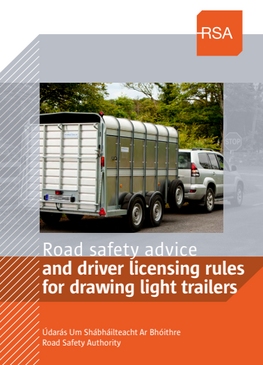
Click to download Drawing Light Trailers Booklet

Stage 1
Theory Test
1-2 Sessions Recommended
Call for Quote
stage 2
Advanced Driver Training
2-3 Sessions Recommended
Call for Quote
stage 3
Instructional Ability
2-4 Sessions Recommended
Call for Quote
Becoming an ADI
How to become an RSA-Approved Driving Instructor (ADI) and what to do if you already hold a relevant qualification.
Get on the Register
To work as a driving instructor in Ireland you must be on the RSA’s Register of Approved Driving Instructors (ADI).
Unless you are on this register and hold a permit from the RSA, it is an offence to work as a driving instructor.
It’s all part of the RSA’s mission to make Irish roads safer.

How to become an ADI
If you wish to become an ADI you must first satisfy the Registrar that you are a person of good character.
There are also specific requirements – you must:
Be tax compliant and in possession of a tax clearance certificate
Hold a full driving licence for the category in which you wish to give instruction for two years
All instructors looking for ADI status must also go through the Garda vetting process.
This provides an extra layer of protection for young learner-drivers.
There are two ways to become an ADI:
The qualification process
There are three stages to the ADI exam:
The Driver Theory Test (part 1) is carried out locally, at one of our 41 test centres nationwide – you can choose a centre that is most convenient to you.
Once you receive your eligibility number from the ADI unit, you can make an appointment via the online booking page or by calling the information and booking line 1890 606 106.
Available appointment times can vary between test centres.
The Driving Test (part 2) and the instruction ability test (part 3) are only available at the following locations: Athlone, Cork, Dundalk, Dublin (Finglas), Galway, Kilkenny, Letterkenny, Limerick, Mullingar, Rathgar, Sligo, Tralee and Waterford.
For more information visit www.theorytest.ie.
Existing qualifications
If you can show that you meet the RSA ADI standard because of qualifications you already hold, there is no need for you to qualify all over again.
But this is something that the RSA needs to verify.
Contact us to arrange an assessment of your qualifications.
Depending on what qualifications you hold, you may be entitled to an exemption from one or all exam stages.
ADI Register
The name of an applicant who passes the three-stage examination or is approved following assessment of their existing qualifications will be entered into the ADI Register.
Fees
There will be a fee for each phase of the application process, including any re-test following a fail.
Questions?
You can contact the RSA at the following address:
Driver Education Section
Road Safety Authority
Primrose Hill
Dublin Road
Ballina
Co Mayo
Click for ADI APPLICATION FORM

EMERGENCY SERVICES DRIVING STANDARD
What is ESDS?
ESDS stands for Emergency Services Driving Standard – a driving standard for Emergency services drivers.
It is open to nominated emergency services drivers who work for the following organisations which form the ESDS Panel (who were involved in the development of the standard). Those organisations include:
What is the purpose of ESDS?
The purpose is to reating a culture of safe and responsible driving is essential for reducing deaths and casualties on Irish roads. The Emergency Services Driving Standard aims to develop and sustain a spirit of cooperation, caution and courtesy in emergency service drivers.
Emergency service drivers should aim to achieve an excellent standard of driving that acts as an example to other road users.
The main aim of this driving standard is to benefit emergency services drivers and other road users by:
Reducing the particular risks associated with the driving of emergency service vehicles
Making sure that patients and passengers are safe and comfortable
Cultivating the attitude that responding to an emergency should never involve actions which could lead to the death or injury of any person.
To become an ESDS Driver
How to become an ESDS driver if you work in an emergency service.
As an emergency service driver you should aim to achieve an exemplary standard of driving that acts as a positive example to other road users.
This will significantly reduce the risks created by driving emergency service vehicles and will benefit you and other road users.
To apply to become a certified ESDS driver you must be nominated by an Emergency Services Organisation that have a current Memorandum of Understanding signed with the Road Safety Authority.
Only drivers eligible to avail of legal exemptions under the Road Traffic Act can undertake ESDS Level 3 training and assessment.
Each organisation will have an appointed ESDS contact person.
How to become an Emergency Services Driving Standard (ESDS) trainer
The role of ESDS trainers and the steps to becoming one.
ESDS trainers help develop competent emergency service drivers who are fully engaged in the act of driving safely and responsibly in accordance with their roles.
As an ESDS trainer you will offer each driver:
How to become a certified ESDS trainer
If you work in an ESDS participating organisation, there are three steps to becoming a certified ESDS trainer:
If you wish to obtain trainer certification, consult with the ESDS contact person in your organisation.
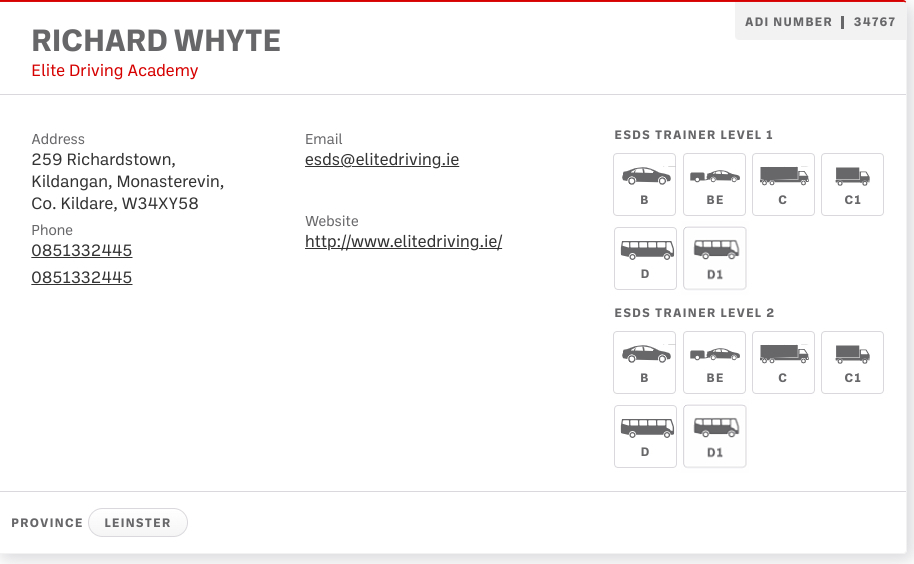
Elite Driving Academy provides ESDS driver training for Car (Cat B), Jeep & Trailer (Cat BE), Truck (Cat C), Ambulance (Cat C1) Bus (Cat D) and Minibus (Cat D1) in both ESDS Level 1 & ESDS Level 2.
Level 3 training conducted within the relevant organisation.
If you would like information on ESDS driver training you can contact us by email esds@elitedriving.ie.

Click on the calendar icon to redirect you to our booking scheduler
Learner driver
Steering you in the right direction
Call for Quote
ADI training
Comprehensive Program
Call for Quote
ESDS Training
Advanced Driver Training
Call for Quote
Combined years of instructing experience OVER
RSA ADI Registered
Instructors
Graduate
Drivers
OVER
Percentage of driving test passes

Myles Conduit
Richie's experience and knowledge of how the process works is invaluable. I passed my coach driving test first time and it would not have been so smooth, if it wasn't for the guidance patience and insight that Richie has.

Oriel O' Gorman
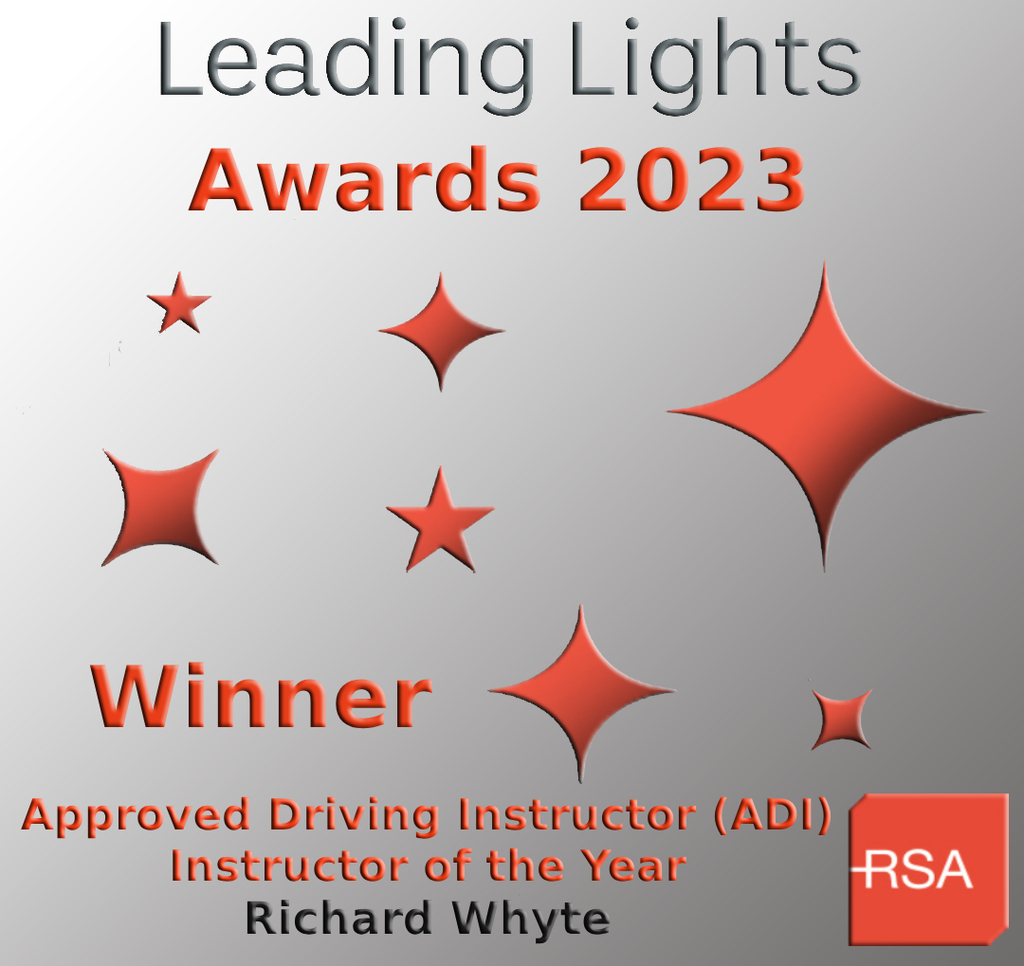
Just a month ago i passed my bus test first time with Richie's help. Richie is extremely knowledgable, and gave me all the information and handouts I needed to pass the cpc walkaround and Bus road test. His instruction was excellent, and he trained me and pushed me to be a "professional driver," as he often said! Richie has a great sense of humour and made the lessons fun too! I had a very reasonable number of lessons, Richie never pushed me to have more than I needed. I am already working, and the operator is very happy with my Skill level. Richie was voted best bus instructor in Ireland for a reason, he's the best! Thanks chief!

Dr. Scotty K
Had a fantastic experience training with Richie to get my truck license (Cat C). He was very informative, gave crystal clear instructions and constructive feedback when needed and always up for a laugh. Would highly recommend Richie to anyone looking to train in any of the categories he offers.

Michael Hodgins
I highly recommend Richie as a driving instructor. I recently passed my bus driving test (D license) and can't thank him enough. When I first met Richie my driving wasn't the best but it came on leaps and bounds during my time with him. He helped me to understand the reasons behind each thing we need to do while driving. Richie takes a very practical approach to driving and has some fantastic learning resources, you'll be well prepared for your driving test and CPC with him. You'll be in good hands, in his hands.

Michal Jaworski
It was a pleasure to have the best instructor in Ireland as my instructor. Can’t thank Richard enough for everything he has taught me and all the study material he has given me. Passed my CPC and D license on my first try due to the excellent service provided by Richard. Would recommend to anyone that wishes to get any type of driving licence

Niamh Ní Leathlobhair
I passed my trailer test on the first attempt after lessons with Richie. He is an excellent instructor, he knows exactly what the testers are looking for, is friendly and had plenty of great tips for remembering the key points needed for passing the test.
The number of lessons varies for each person, but on average, most learners need around 40-50 hours of professional instruction plus additional practice with a sponsor. We'll assess your progress as we go and guide you accordingly
Typically, a lesson lasts 1 to 2 hours, depending on your preference and of course on the category you are seeking lessons for. Many students find 2-hour lessons more productive, as we can cover more ground in one session.
Taking lessons with a qualified instructor can be a significant investment, but it ultimately pays off in the long run by equipping you with a valuable life skill that extends far beyond passing the driving test. We recommend scheduling at least 1-2 lessons per week, depending on the category, to ensure consistent progress. More frequent lessons can help reinforce your skills and shorten the time needed to become test-ready.
Our pricing structure varies based on the duration and type of lesson you choose. For the most up-to-date rates, we encourage you to reach out to us directly. Additionally, don't forget to inquire about special discounts that may be available for block bookings, which can provide excellent value for your investment in learning. We look forward to hearing from you!